









You’re strolling through a local market when you come across a nice stall full of old comic books. It turns out to be a small business owner who has been buying and selling old comic books at local markets for years.
You buy some old Suske & Wiske comic books. You pay and walk on, but a little later you suddenly realize that you didn’t receive an invoice, receipt, or anything else for your purchase. Did that market vendor just sell you something under the table?
Not at all. The market vendor is using a daily receipts book.
What is a daily receipts book? 📓
A daily receipts book, sometimes referred to as “daily receipts” or simply “receipts book,” is a document in which self-employed individuals can record their receipts.
As a self-employed person, you typically issue a sales invoice. This sales invoice serves two purposes:
- You enter the issued sales invoice into your accounting records. The amount on that sales invoice represents revenue for your bookkeeping. So, it’s important information for your books.
- You give the sales invoice to the buyer. This way, the buyer has a document stating what they purchased from you, how much they paid for it, your bank account number (if they still need to pay), terms and conditions…
Now imagine a situation where the buyer does not need that second point. Consider, for example, the earlier comic book example:
- The buyer has purchased something small. They do not care that they did not receive an invoice describing the purchased item and stating the amount paid.
- The buyer also paid immediately (cash, Bancontact… it doesn’t matter) and therefore doesn’t need to know your bank account number or the applicable terms and conditions afterward.
Then you’re exactly in the situation of daily receipts! Such situations occur in many industries, such as bakeries, hair salons, butchers, psychologists, (physical) stores…
If your buyer is a private individual who does not specifically ask for a sales invoice, then as a self-employed person you are not required to create a sales invoice for the customer. In that case, you may use an entry in the daily receipts book.
You may use the daily receipts book regardless of how your private customer paid (bank card, cash, meal vouchers, Payconiq).

Please note!
A daily receipts book is not a cash book! Would you like more information about cash books?
What is the advantage of a daily receipts book? ✅
Let’s go back to the market vendor selling comic books. He sold no fewer than 100 comic books that day.
That would mean he would have had to issue 100 sales invoices that day. And actually, immediately after each sale, because his customers want to get on with their shopping quickly. That’s quite a lot of paperwork for the market vendor.
Fortunately, he can also opt for the daily receipts approach. At the end of the day, he simply notes in his receipts book that he sold 100 comic books and the total amount he received. With a single line in his daily receipts book, he fulfills his administrative obligations!
That’s a significant time-saver compared to creating 100 sales invoices.
How are daily receipts recorded in my accounting? 🧾
In the same way as sales invoices. From an accounting perspective, there is no difference between income from sales invoices and income from a daily receipts book.
One option is that the market vendor actually issues 100 sales invoices, selling each comic book for 2 euros. This results in 200 euros in income for his accounting records.
Or, our market vendor notes on a single line in his daily receipts book: 100 comic books sold; 2 euros each; 200 euros in income. That amounts to exactly the same as above: 200 euros in income for his bookkeeping.
So it’s safe to say that a daily receipts book actually makes bookkeeping easier. You don’t have to enter each sales invoice separately into your accounts; you simply copy the total amount from your daily receipts book.
On top of that, there’s the enormous time savings for the market vendor, since he doesn’t have to create 100 sales invoices.
How do I fill out my daily receipts book? 🔎
Paper daily receipts
⚠️ Please note: only the legally approved version is valid! It has many rules to ensure that people cannot falsify their records.
- You must fill out the book every day, even if there is no income that day.
- Break down the entries according to the VAT rate.
- Is an item more expensive than €250? Put it on a separate line.
- Write with something that cannot be erased (not with a pencil 😉).
- Made a mistake? You cannot erase anything!
- Make corrections separately without overwriting/deleting the original entry.
- You must record the total amount per day.
- Make sure the pages are numbered.
- Number all lines as well.
- Include your VAT number on every page.
- Also total everything monthly and close out each month.
Digital daily receipts
Fortunately, the regulations have been updated, and you can now keep track of your daily receipts digitally. This is much more efficient than using paper!
The government has set very strict rules for digitally tracking your daily receipts; you can find more information about this in circular letter 2020/C/20. For example, it must not be possible to modify or delete data without leaving a digital trail.
⚠️ Please note: Using Excel to track your daily receipts is therefore insufficient and could even result in fines ranging from 50 to 4,000 euros!
To meet all requirements, you must use specialized software such as Dexxter. This software takes all regulations into account, ensuring you are not at risk.
Either a sales invoice or a daily receipt. Never both!
You can use both invoices and daily receipts, such as when you sell comic books to both individuals and businesses. After all, those businesses will want an invoice.
But… what should you avoid doing? Creating a sales invoice and entering a daily receipt for the same sale. That’s a common mistake. So it’s one or the other. If you combine both, you’ll end up reporting the same income twice in your accounting, and we certainly don’t recommend that!
Double revenue naturally means (unjustified) higher profits in your books, which means you’ll have to pay (unjustified) higher taxes.

Tip from an accountant
Never forget to correct your daily receipts if a customer asks for an invoice afterwards.
Daily receipts have already been entered, but the customer requests an invoice afterwards
You definitely don’t want to enter both a daily receipt and an invoice, because that would result in reporting more income than you actually earned. You also know by now that you’re not allowed to delete entries in the daily receipts book, so what should you do instead?
Don’t worry, making a correction afterwards is allowed. Of course, you must take the legal rules into account when doing this. The original must therefore still be legible, and you must provide a reason for the correction. In this case, the reason could be: “Customer requested an invoice afterwards.”
✅ With accounting software such as Dexxter, this is done correctly for you automatically.
On which day should I record my daily receipts?
The law requires that you fill out the daily receipts book every day.
But when should you record the receipts? At the time of sale? At the time of payment? Or when the money is deposited into your account?
The answer: you record them on the day you receive the payment. So for a cash payment, that’s the same day; for a bank transfer, it’s the day the money arrives in your account.
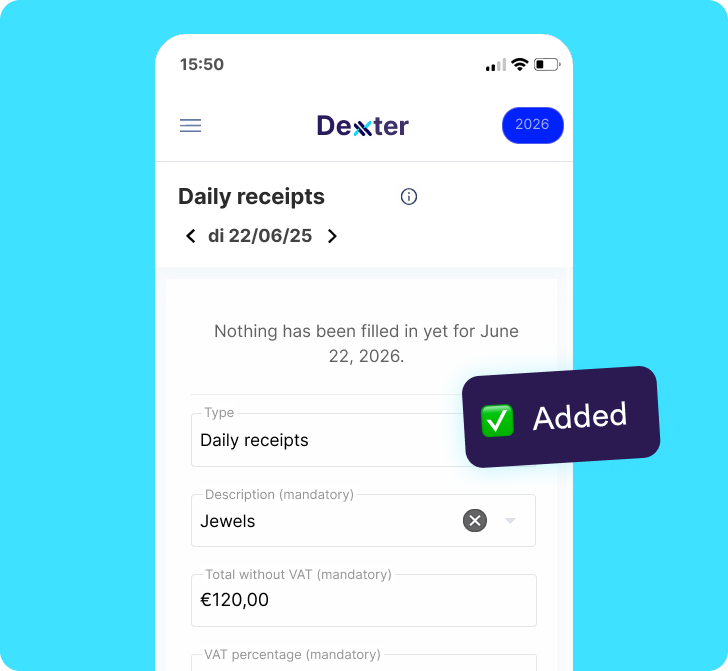
Entering your daily receipts in Dexxter 💪
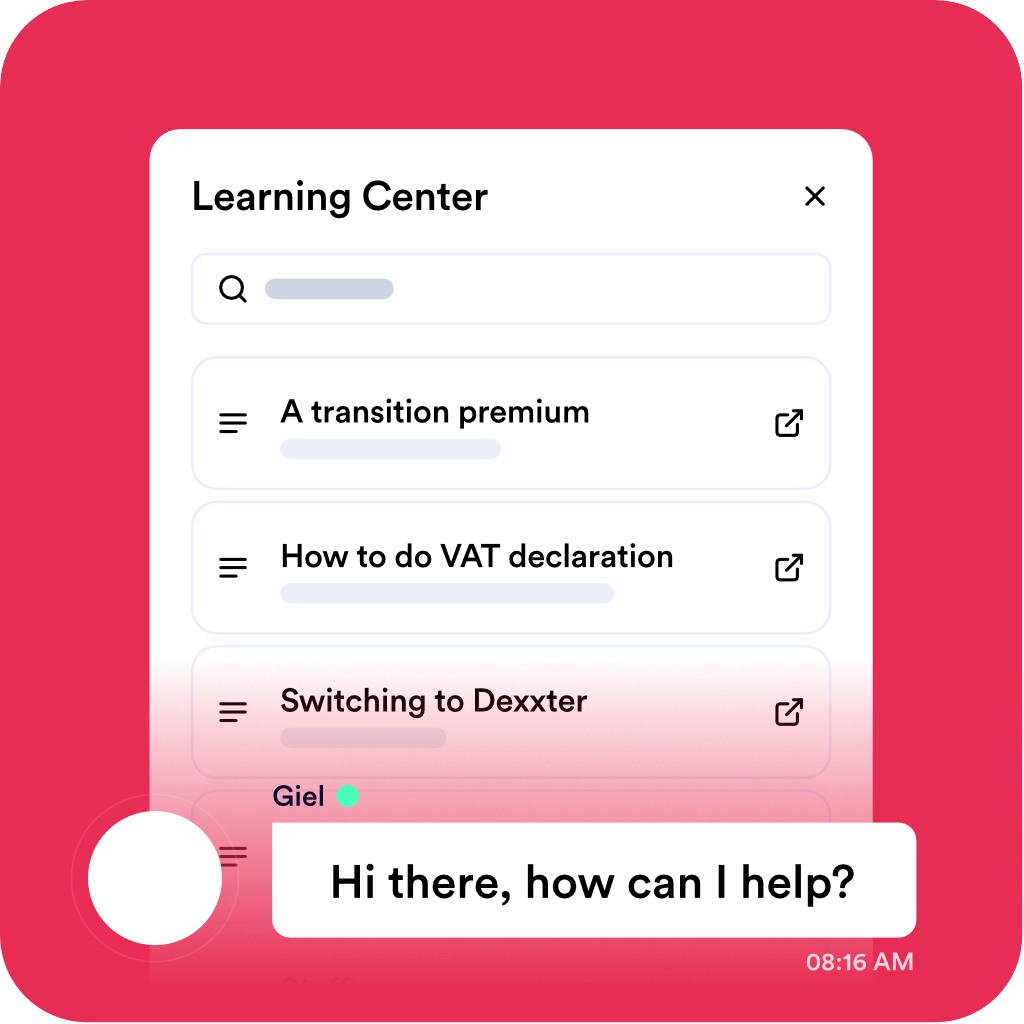
It’s very easy to manage your daily receipts yourself in Dexxter. Our accounting software processes everything correctly and in compliance with the law, so you don’t have to worry about a thing. In the app’s learning center, you’ll find additional information on exactly how to enter daily receipts in Dexxter.