You have a regular job and run your own small business on the side. That’s smart. But that means one more thing to deal with: accounting. Issuing invoices, recording expenses, filing VAT declarations if necessary. It sounds complicated, but it doesn’t have to be that way. On this page, you’ll learn exactly what accounting entails for the self-employed in secondary occupation, what the rules are, and how to keep things as simple as possible.





If you have a secondary occupation, you are officially registered as self-employed, even if you only work part-time on your own account. This means you have the same accounting obligations as the self-employed in main occupation, except that your social security contributions and taxes are calculated differently.
In most cases, the accounts of a secondary-occupation worker are kept using simplified accounting. You are not required to file financial statements. However, you must record the following:
Good news: as a sole proprietor in secondary occupation, you are eligible for simplified accounting rules. No double-entry bookkeeping, no filing requirement. However, you must keep everything neatly organized so you have nothing to fear in the event of a tax audit.
This is the question most people with a secondary occupation ask. And rightfully so: your expenses determine how much tax you pay. In principle, you can deduct everything you spend for business purposes from your income.
Professional expenses are costs you incur to carry out your business activity. The tax authorities check whether they:
These are the most common expenses for the self-employed in secondary occupation:
You book your expenses as soon as you incur them, regardless of when you pay them. On your tax return, you report the total of all business expenses for the entire fiscal year. You do not need to do this on a quarterly basis. Dexxter automatically categorizes your expenses. You can see at a glance what expenses you’ve incurred and what you can deduct. No separate spreadsheet needed.
You may deduct a part of your housing expenses (rent, utilities, internet) based on the surface area you use for professional purposes. If you use 15% of your home as an office, then 15% of those costs is deductible. Always make a clear calculation and keep a record of it.
If you have a secondary occupation, you pay social security contributions, but you do not accrue any additional social security benefits. After all, you are already covered through your main job. Nevertheless, you are required to pay these contributions.
You pay social security contributions on the net income from your secondary occupation. This is your turnover minus your deductible expenses. The rate is the same as for the self-employed in main occupation: approximately 20.5% of your net professional income.
As a self-employed person in secondary occupation, you are exempted from social security contributions as long as your net taxable annual income remains below a certain threshold. Once you exceed that threshold, you pay a contribution starting at a minimum of approximately 99.96 euros per quarter (2026, indicative). As your income increases further, this amount also goes up.
Your social security contributions for this year are calculated based on your income from three years ago. In the first few years, you’ll pay provisional contributions. A final settlement will follow later. Set aside a buffer: count on approximately 20% of your net professional income.
Do you earn little in your secondary occupation? If so, you may be eligible for a partial or full exemption from social security contributions. The threshold and conditions are strict: check with your social insurance fund (Acerta, Xerius, Liantis, or another).
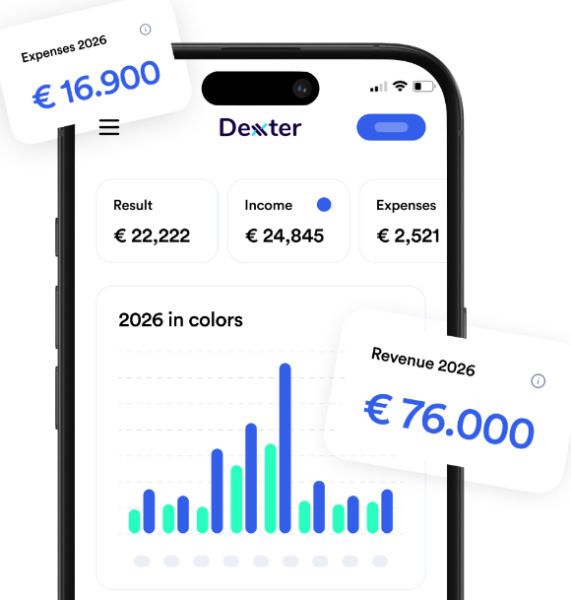
In Dexxter, you can see a real-time projection of how much you need to set aside for social security contributions. That way, there are no unpleasant surprises later on.

Dexxter calculates a real-time estimate of your expected taxes based on your invoices and expenses. That way, you always know how much to set aside.
Two questions that concern many self-employed people in secondary occupation: do I have to charge VAT, and how much tax do I pay on my side income?
This depends on your activity and your turnover. Rule of thumb:
Do you qualify for the VAT exemption for small businesses? If so, state the following on your invoice: “Small business subject to the exemption scheme. VAT not applicable.” You do not charge VAT, nor can you claim a VAT deduction on your purchases.
Your additional income as a self-employed person is added to your other income and taxed under the personal income tax system. The tax burden depends on your total taxable income. For your secondary occupation, you therefore pay tax at the highest rate applicable to you, because the additional income you earn is taxed on top of your salary as an employee.
Suppose you earn 1,000 euros gross in your secondary occupation. You have 200 euros in expenses. Your net professional income is then 800 euros. Social security contributions: approximately 164 euros.
Taxable income: 636 euros. At a marginal tax rate of 50%, you’ll pay approximately 318 euros in taxes. You’ll be left with approximately 318 euros net after 1,000 euros of turnover. Set aside at least 35 to 40% of your turnover for taxes and contributions.
Dexxter is built for Belgian sole proprietorships. Self-employed people in secondary occupation make up our largest customer group. Our tool is designed in such a way that you don’t need any accounting knowledge to record everything correctly.
Create invoices in less than a minute Select a client, add your service, and hit send. Dexxter automatically fills in your VAT status, your Peppol address, and all required legal information. No more mistakes, no more forgotten required fields.
Record expenses by photo or email Take a photo of your receipt with the app. Dexxter uses AI to recognize the amount, date, and category. Your expenses are always up to date, even on the go.
VAT declaration in 3 minutes If you’re subject to VAT, Dexxter collects all the data and prepares your declaration. You simply review and confirm. Done. You’ll never have to search Intervat again to figure out what to enter.
Real-time tax forecast Dexxter shows you at any time how much you need to set aside for taxes and social security contributions. Based on your actual income and expenses, not on estimates.
Mobile app for on the go Do you prefer to do your bookkeeping on your phone? The Dexxter app works on iOS and Android. Send an invoice from the train? Scan a receipt after a client visit? Anything is possible.
“I was afraid that bookkeeping would take a lot of time. With Dexxter, I do everything on a Sunday evening in half an hour. It really is that simple.”
Graphic designer in secondary occupation, Antwerp

🇧🇪
As a self-employed person in secondary occupation, you balance your regular job with your own business. You don’t have time to spend hours on spreadsheets. Dexxter keeps track of everything while you focus on your actual work.
Not sure how much tax you’ll have to pay? Dexxter calculates a real-time forecast based on your actual figures. That way, you’ll always set aside the right amount.
Every deductible expense you forget is money you’re overpaying to the tax authorities. Dexxter helps you record your expenses and categorize them correctly, so your deductions are complete when filing your declaration.
VAT rules, the Peppol requirement, the small business scheme: Dexxter automatically updates itself. That means you don’t have to spend time keeping up with the latest legislation.
On average, Dexxter customers spend less than an hour a month on accounting. That’s the time of a single meeting.
Do you have a question about your VAT status, an invoice, or an accounting term? Dexxter support responds within two hours on average on business days. No additional cost.
A self-employed person in secondary occupation who spends 3 hours a month on accounting (administration, invoices, recording expenses, declarations) loses 36 hours a year. At an hourly rate of 60 euros, that amounts to 2,160 euros in lost income or free time. Dexxter will cost you 220 euros per year if you’re not subject to VAT. The math speaks for itself.
Monday, 8:00 p.m.: Sending an invoice after a project
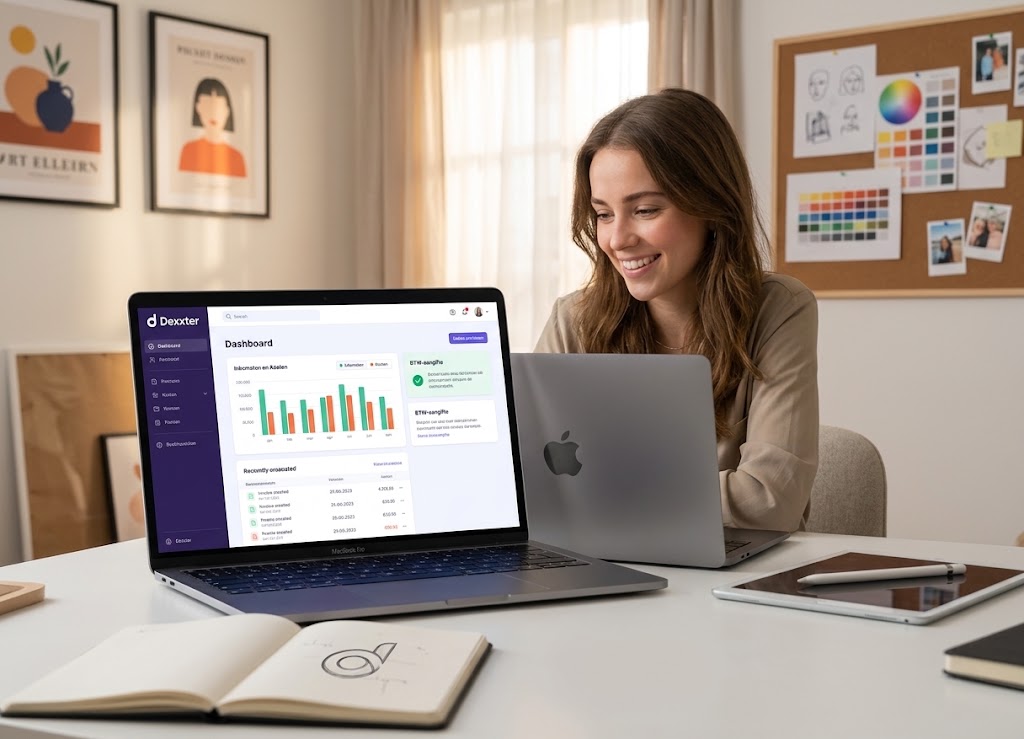
Jasper designed a logo for a client. He opens Dexxter on his laptop, selects the client, and adds his service. The invoice is sent in two minutes. A reminder is automatically scheduled if the client doesn’t pay.
Tuesday on the train: Scanning a receipt
He took a professional training course and kept his train ticket. He takes a photo in the Dexxter app. The amount and date are automatically recognized and categorized as training expenses.
Saturday, first weekend of October: VAT declaration
Jasper’s VAT declaration for Q3 is ready in Dexxter. He checks the figures—everything adds up. He confirms the declaration. Only ten minutes of work.
February: Preparing the tax return
Jasper opens the tax report in Dexxter. His total income, his professional expenses, his social security contributions: everything is neatly listed. Whether he has his accountant file the return or fills it out himself: both options can now be completed in five minutes.
"I used to have an Excel file with invoices and a separate folder for receipts. I always forgot something. Now I do everything in Dexxter and I know it’s all correct."
| Feature | Excel / manually | Dexxter |
|---|---|---|
| Creating invoices | ✓ (manually) | ✓ (automatically) |
| Correct legal mentions | Check them yourself | Filled in automatically |
| Peppol / e-invoicing | ✗ | ✓ |
| Payment reminders | ✗ | ✓ |
| Recording expenses trough the app | ✗ | ✓ |
| VAT declaration preparation | Manually | Automatically |
| Realtime tax forecast | ✗ | ✓ |
| Error notificatin for missing data | ✗ | ✓ |
| Support | ✗ | ✓ (avg. 2h response time) |
| Price | Free (but requires time investment) | Starting at 220 euros/year |
Excel is free, but it costs you time and increases the risk of errors. Dexxter takes over your bookkeeping so you can focus on your customers and your regular job.
This is not required by law for sole proprietorships. However, it is strongly recommended: this allows you to keep your personal and business expenses strictly separate, which makes your accounting—and any future audit—much easier.
In terms of accounting obligations, there’s hardly any difference. Both fall under the simplified accounting system for sole proprietorships. The difference lies in social security contributions (secondary occupations pay less and accrue fewer benefits) and in the calculation of taxes (your additional income is taxed on top of your salary).
That depends on your activity and your turnover. If your annual turnover is under 25,000 euros, you can opt for the VAT exemption scheme for small businesses. If you exceed that threshold, or if you engage in an activity for which VAT is mandatory, then you are subject to VAT.
By law, you must keep accounting documents for 7 years. Digital copies are officially accepted. Dexxter automatically stores all your invoices and expenses in the cloud.
Yes. The costs of an accounting tool or an accountant are deductible business expenses. So if you use Dexxter, the subscription is fully deductible.
You can file an amended declaration through Intervat. Dexxter includes penalty protection: if a penalty results from a software error, Dexxter will reimburse you. If you make a mistake yourself, please contact the VAT administration or your accountant.
On average, less than an hour per month. That covers your invoices, your expenses, and your quarterly declaration.
Yes. When you create your account, you’ll enter your VAT status. Dexxter automatically adjusts the invoice layout and the declaration module. If your status changes later on, you can update it in your settings.
For whom?
All Belgian 🇧🇪 sole proprietorships
Not available for corporations
Features
Never alone
Features
For whom?
All Belgian 🇧🇪 sole proprietorships
For whom?
For whom?
All Belgian 🇧🇪 sole proprietorships
Not available for corporations
Features
Never alone
Never alone
Features
For whom?
All Belgian 🇧🇪 sole proprietorships
Not available for corporations
🇧🇪
01 — Your turnover is growing rapidly If your annual turnover exceeds 25,000 euros, you become subject to VAT (unless your activity is exempted). That entails some extra paperwork, but no need to worry: with a smart accounting tool like Dexxter, you can smoothly manage this transition and handle your VAT obligations effortlessly on your own.
02 — You want to maximize your deductions Accountants know which expenses are deductible and which aren’t for your specific business. If you’re unsure, a single consultation can save you hundreds of euros.
03 — Your business is getting more complex Do you work for multiple clients, are you planning to hire staff, or do you want to set up a corporation in the future? In that case, professional advice isn’t a luxury.
04 — You don’t have enough time As a self-employed person in secondary occupation, you already have a busy schedule. If accounting causes you stress, outsourcing is a real option. An accountant for self-employed individuals in secondary occupation costs an average of 500 to 1,500 euros per year, depending on the complexity.
05 — You are facing a tax audit During an audit, you want everything to be spot on. If you’ve never sought professional advice, now is the time to do so.
06 — You want to stay in control Many self-employed people in secondary occupation opt for an accounting tool like Dexxter and consult an accountant only for specific questions. The combination of maintaining your own overview and getting tailored advice yields the best results.
Yes. The tax authorities may ask you to provide proof of expenses. Digital copies are officially accepted. Keep your receipts for at least 7 years, even if you’ve already scanned them.


.svg)
