.svg)

As a self-employed person, you can choose to use professional expenses that you enter in your accounts using receipts or invoices. The sum of these costs is deducted from your turnover. On the remaining profit you will be taxed.
You can also opt to use flat-rate expenses. This is a fixed percentage of costs that you may deduct from your turnover. The amount of that percentage depends on your situation (see below).
The percentage of flat-rate expenses is not that high, so usually you are better off with actual professional expenses. The advantage of a flat-rate expense allowance is that you don’t have to keep receipts or invoices.
So the choice is yours. Attention, a combination is not possible. However, you can decide again each year.
How much is the flat-rate expense allowance for the self-employed?
Here is a comparison of the flat-rate professional expenses for the self-employed in Belgium, per category and per assessment year.
| Category of self-employed person | Assessment year 2026 (income year 2025) | Assessment year 2027 (income year 2026) |
|---|---|---|
| Sole proprietorship in a secondary or main occupation (not a liberal profession) | 30% of gross profit, max. €5,930 | 30% of gross profit, max. €6,070 |
| Liberal profession (care provider, lawyer…) | By brackets on your gross receipts after social security contributions and VSPSS, max. €5,210 | By brackets on your gross receipts after social security contributions and VSPSS, max. €5,340 |
| Assisting spouse | 5% of professional income after social security contributions, max. €5,210 | 5% of professional income after social security contributions, max. €5,340 |
Box XVII of the personal income tax (industrial, commercial or agricultural enterprises)?
Do you declare your self-employed activity in box XVII of the personal income tax (industrial, commercial or agricultural enterprises)?
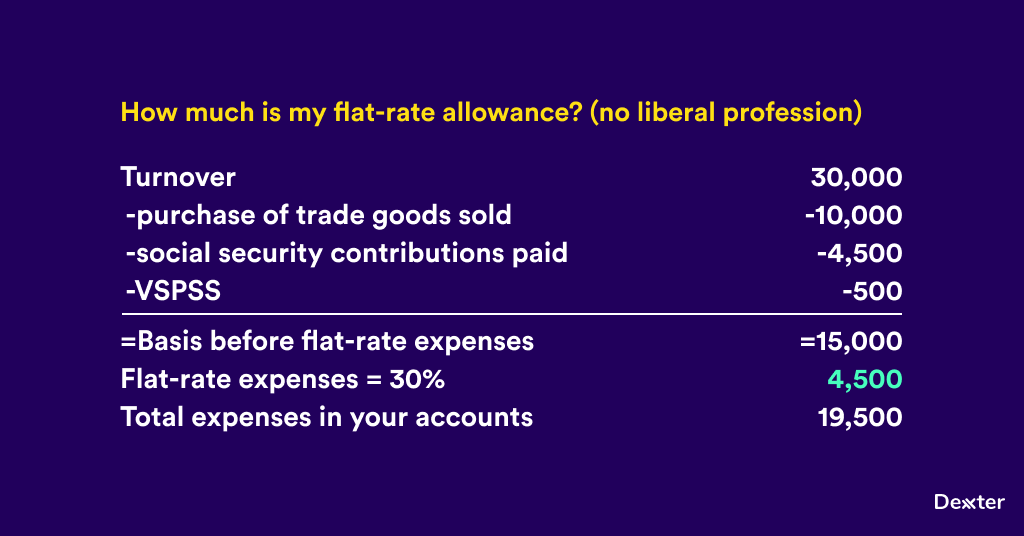
Then your flat-rate for expenses can be a maximum of 30% of your gross profit. You obtain that gross profit by reducing your turnover with the purchase of the trade goods you sold, and then also with your paid social security contributions and your VSPSS. It is that result you apply the 30% to. Your social security contributions and your VSPSS are then still deducted separately as actual expenses, because they are not included in the flat rate.
Watch out!
There is an absolute upper limit for the flat-rate expense allowance of €6,070 per year for income year 2026 (assessment year 2027). Those 30% therefore run up to a gross profit of €20,233.33. For income year 2025 the limit was €5,930.
Tip

Practical example
You start a webshop in a secondary occupation and generate €8,000 in turnover. You bought €1,600 worth of trade goods and paid €400 in social security contributions.
That leaves you with a basis of €6,000, which is your turnover minus the purchase of the trade goods you sold and minus your paid social security contributions. You may apply a 30% flat rate to that, so €1,800, for which you do not have to file any documents. Your €400 in social security contributions is then still deducted separately as an actual expense, because it is not included in the flat rate.
Box XVIII of the personal income tax (income from liberal professions, posts, positions or other profitable occupations)?
Do you declare your self-employed activity in box XVIII of the personal income tax (income from liberal professions, posts, positions or other profitable occupations)?
Then you must calculate the flat-rate expenses according to brackets:
| Bracket of your gross receipts after social contributions and VSPSS | Percentage | Cumulative |
|---|---|---|
| Up to €7,720 | 28.7% | €2,215.64 |
| €7,720 to €15,340 | 10% | €2,977.64 |
| €15,340 to €25,530 | 5% | €3,487.14 |
| €25,530 to €87,291.83 | 3% | €5,340 |
With an absolute maximum of €5,340 per year for income year 2026 (assessment year 2027). For income year 2025 that maximum was €5,210. Paid social security contributions or a VSPSS can still be deducted separately as expenses.
Practical example
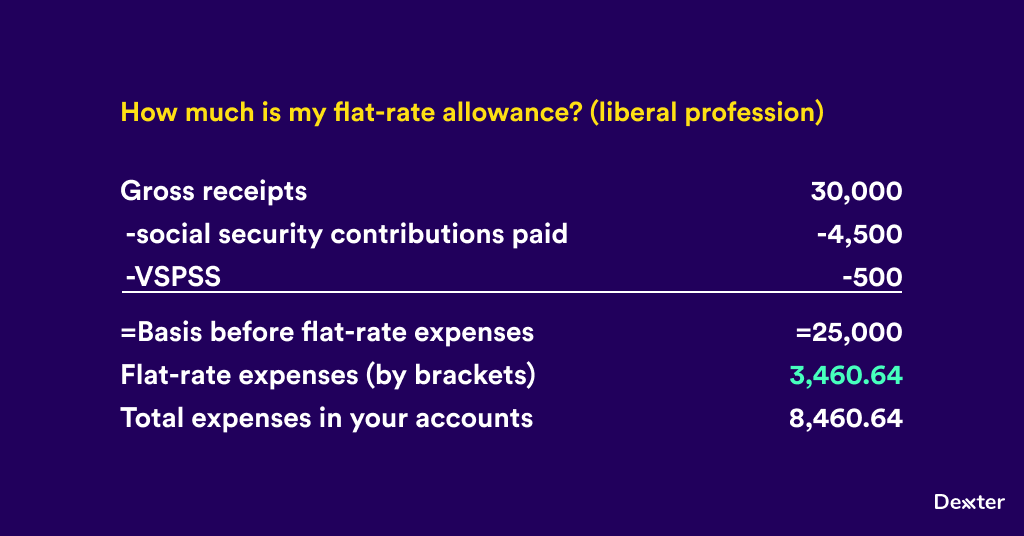
A beginning lawyer made €30,000 in turnover in his starting year. He paid €4,500 in social security contributions during the year and a VSPSS worth €500.
He does not apply the brackets to his full turnover, but to his gross receipts after deducting his social security contributions and his VSPSS, so to €25,000. With the brackets above that gives flat-rate expenses of €3,460.64. His €4,500 in social security contributions and his €500 VSPSS are then still deducted separately as actual expenses.
| €25,000 base (gross receipts after social contributions and VSPSS) | Calculation | Total |
|---|---|---|
| Bracket 1 (€7,720) | €7,720 × 28.7% | €2,215.64 |
| Bracket 2 (€7,620) | €7,620 × 10% | €762.00 |
| Bracket 3 (€9,660) | €9,660 × 5% | €483.00 |
| Total flat-rate expenses | = €3,460.64 |
Assisting spouse
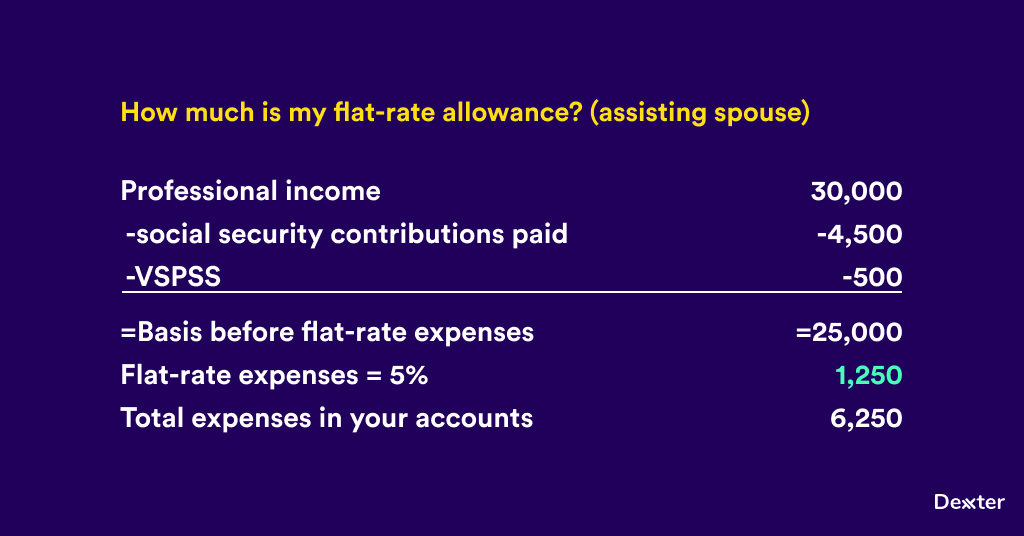
As an assisting spouse you can deduct 5% of your professional income after deducting your social security contributions as flat-rate expenses, with a maximum of €5,340 for income year 2026. Considerably lower, then, than with any other status.
Practical example
I am subject to VAT and want to recover VAT?
The VAT authorities do not work with flat rates. If you want to recover VAT, you must process your purchase invoices in your accounts.
You can, however, recover VAT via your purchase invoices on the one hand and, on the other hand, when filing your personal tax return, go for the amount of the flat-rate expenses.
Can I decide afterwards which system to apply?
Sure, you can enter the actual professional expenses in your accounting and find at the end of the year that the flat-rate professional expenses are higher.
In that case you simply leave the code for your actual expenses empty in your annual personal income tax return. The tax authorities then apply the flat rate themselves. So you do not enter the flat-rate amount in that code, and that is exactly where it often goes wrong.
Although the likelihood that the flat-rate expenses will in fact be higher than your actual professional expenses is fairly small.
How do I choose flat-rate expenses?
By not entering any actual expenses in your personal income tax return. If you leave that code empty, the tax authorities grant you the flat rate automatically. If you do enter an amount, they calculate with that amount, even if the flat rate would be higher.
For box XVII of the personal income tax (industrial, commercial or agricultural enterprises), use code 1606.
For box XVIII of the personal income tax (income from liberal professions, posts, positions or other profitable occupations) use code 1657.
Yes. At the last step of your personal income tax return, Dexxter automatically compares your actual professional expenses with the flat-rate allowance you are entitled to.
If the flat rate is more favourable, Dexxter does not enter your actual expenses in code 1606 (box XVII) or code 1657 (box XVIII). Only then do the tax authorities apply the higher flat rate. A message explains why that code stays empty.
If your actual expenses are equal or higher, nothing changes and Dexxter enters them as usual. You can always choose to show your actual expenses anyway, with a toggle, along with a warning that you lose money that way.
Two things still apply. You must keep your purchase invoices if you want to recover VAT, because the VAT authorities do not work with flat rates. And your paid social security contributions can still be declared separately alongside the flat rate, Dexxter takes that into account.
Tip

Tip from an accountant
“The tax authorities do not automatically choose the most favourable system for you, and that is exactly why Dexxter makes that comparison itself when filing your return. For most sole proprietorships with some expenses, working with actual expenses remains more favourable anyway.”
Conclusion
The flat rate is not always favourable, because it is limited to 30% of your gross profit with a strict maximum amount. Anyone with a lot of expenses is almost always better off with actual expenses.
But for anyone with few expenses it is exactly the other way around. And that is where it often goes wrong: if you enter actual expenses that are lower than the flat rate, the tax authorities calculate with that lower amount. Dexxter compares the two automatically when you file your return, so you do not have to make that comparison yourself.