










Can you simply record a mobile phone costing less than €250 as an expense, or do you need to register it as an investment?
This is a question that regularly comes up in our Dexxter community. That’s why, in this article, we explain how to handle a purchase of less than €250, what the tax rules are, and how to register this correctly in your accounts.
What is a business expense?
A business expense is an expense that is directly necessary for your business and the amount of which you may deduct in one go in the year of purchase.
✔️ Often involves smaller or shorter-term purchases
✔️ Is immediately recorded in full as an expense
✔️ Immediately reduces your taxable profit
Examples: office supplies, software subscriptions, small equipment, etc.
What is an investment?
An investment is a purchase that lasts longer than one year in your business and usually has a higher value.
This is not deducted in one go, but gradually via depreciations (spread over several years).
✔️ Durable goods
✔️ Higher purchase price (in Belgium, the €250 excl. VAT threshold serves as a guideline)
✔️ Activated as fixed assets
✔️ You record a portion of the expenses as a cost each year (= depreciation)
Examples: laptop, machine, camera, car, large tools, etc.
Why is there a difference between business expenses and investments?
The Belgian tax authorities make a clear distinction between business expenses and investments.
For purchases under €250 excl. VAT, you may immediately record the full amount as an expense. You therefore do not need to record the item as an investment and depreciate it over several years. Even if the item actually lasts longer.
You may register it as an investment if it remains in your business for the long term, but this is not an obligation as long as you stay below the €250 threshold.
➡️ Example: You buy a mobile phone for €199 excl. VAT. You may register this in full as an expense in the year of purchase.tytyh
Why is €250 the threshold?
The €250 limit is not a legal requirement, but a practical rule used by many accountants. It helps determine which minor purchases you can immediately record as an expense.
Originally, this limit stemmed from the old VAT rules. Purchases under €250 were then regarded as “small items” and did not need to be recorded as an investment or business asset. This simplified the administration.
Today, the VAT threshold has been raised to €1,000, but in practice the €250 limit remains useful. The tax authorities readily accept small purchases below this amount as business expenses. This allows you to record them quickly and hassle-free, even if they last for several years.
In short: €250 is a useful rule of thumb for the self-employed to process small purchases correctly and easily.
Attention! We are talking here about the threshold amount for expenses! VAT administration, on the other hand, applies an other limit, namely €1,000. Don’t worry, Dexxter automatically takes these matters into account.
So how does it work in practice?
Under €250
→ Almost everyone records this directly as an expense.
Why? Because it’s small equipment and the tax authorities will never dispute it.
€250 – €1,000
→ Grey area.
You have the option of selecting expense or investment. There is no law requiring you to record it as an investment, unless it is clearly a durable item (e.g. a laptop).
From €1,000
→ For accounting and tax purposes, this is clearly an investment. You must therefore depreciate it. This is also supported by the VAT threshold of €1,000.
How do you record this in Dexxter?
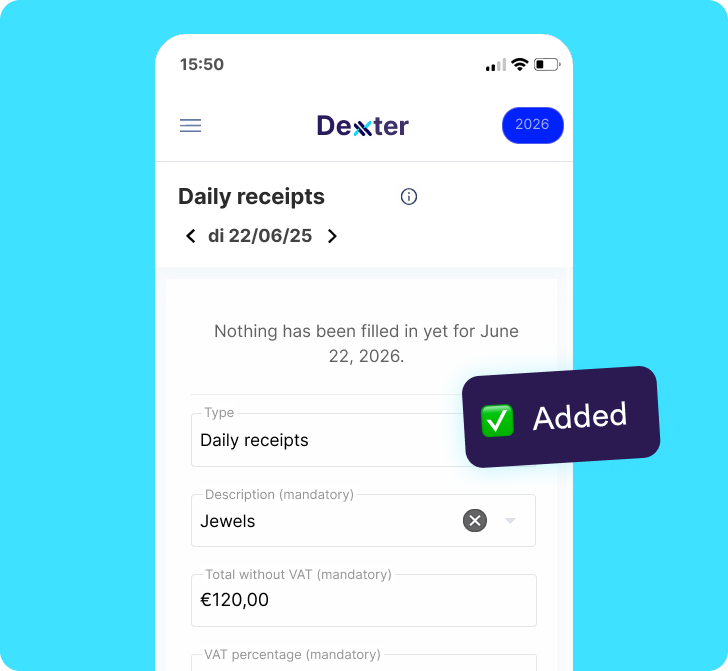
In Dexxter, you simply record this as a business expense in the ‘miscellaneous small purchases’ category.
Based on the amount and the expense type, the system knows that this is not an investment.
No depreciation required, no separate transactions, just processed quickly and correctly.
View our video on expense versus investment
Would you like an explanation on how to process small purchases correctly?
👉 View the video:
Any questions about business expenses?
Are you unsure about how to process a purchase, or do you want to be sure you’re doing it correctly in accordance with Belgian accounting legislation?