












The concept of net taxable income appears everywhere in Belgian taxation: in your tax return, in social security contributions, and in statuses such as student self-employed or self-employed in a secondary activity. Yet for many self-employed people, it remains a vague and confusing concept. Time to clear that up.
In this blog, we explain step by step what net taxable income is, how it is calculated, and why it is so important.
What does net taxable income mean?
Net taxable income is the amount on which you ultimately pay personal income tax.
So it is not the same as your turnover, and it is not simply your profit.
You can see it as the final result of several calculations, in which certain costs and deductions are subtracted at each step.
From turnover to net taxable income
For self-employed people, the calculation usually follows this order:
1. Turnover
This is everything you invoice to clients, excluding VAT.
2. Professional expenses
All the costs you incur to run your business, such as materials, software, travel, marketing, and part of your phone or internet.
Turnover minus professional expenses gives you profit.
3. Social security contributions
The social security contributions you pay as a self-employed person are tax deductible.
After deducting these contributions, you arrive at your net taxable income.
This is the amount on which the tax authorities calculate your personal income tax.
Difference between taxable income and net taxable income
These two terms are often used interchangeably, but they do not mean exactly the same thing.
Taxable income
Usually the income after professional expenses, but before deducting social security contributions.
Net taxable income
Taxable income after deducting social security contributions and other tax deductions.
This is the final amount that ends up in the tax brackets.
For many tax thresholds and statuses, the government specifically looks at this net taxable income.
Why is net taxable income so important?
Net taxable income determines, among other things:
- How much personal income tax you pay
- Whether you can remain financially dependent on your parents as a student self-employed
- Your social security status as a self-employed person
- Whether you retain eligibility for certain benefits or allowances
- Which tax brackets apply to you
A small change in this amount can therefore have major consequences.
What if you are both self-employed and employed?
If you are self-employed in a secondary activity alongside a salaried job, your net taxable income is added to your salary. The tax authorities therefore look at your total income, not at each activity separately.
Your salary is first taxed through withholding tax. Your self-employed income is then added on top in your personal income tax. Your employer already makes advance payments for your personal income tax, but for your secondary activity you will need to do this yourself.
Because your salary and your self-employed income are combined, your self-employed income may fall into a higher tax bracket, even if your self-employed profit seems limited.
That is why it is important to track your income carefully. This helps you avoid having to pay unexpectedly high taxes at the final assessment. With a clear overview of both your salary and your self-employed activity, you always know your true tax position.
Common misconceptions
A common mistake is thinking that you pay tax on your turnover. That is not correct.
You pay tax on your net taxable income, after costs and social security contributions.
Income thresholds are also often misinterpreted. When a limit is set based on net taxable income, it is not about what is on your invoices, but about what remains after all deductions.
How does Dexxter help?
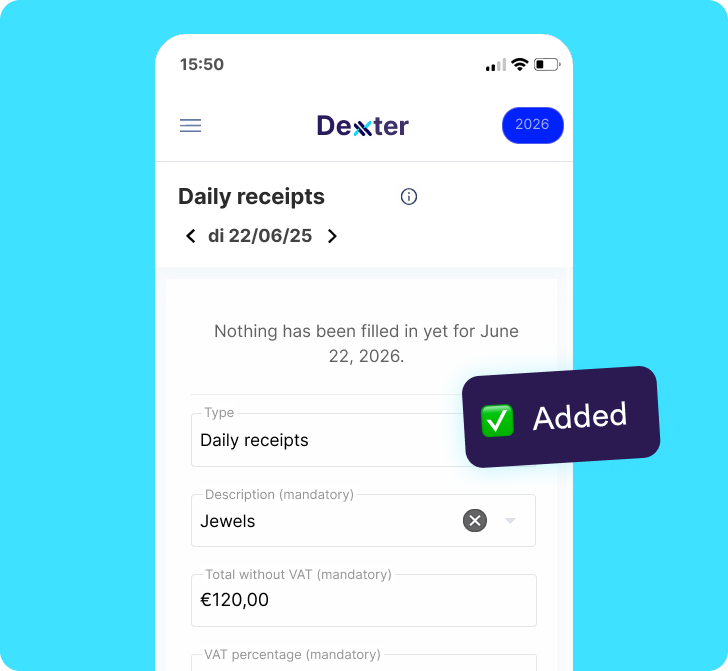
With Dexxter you can easily track:
- your income and expenses
- your profit after costs
- a realistic estimate of your social security contributions
- a clear view of your net taxable income
This way, you always know where you stand and you avoid surprises when filing your tax return. With Dexxter you know exactly how much advance tax you need to pay and how much social security contributions you owe.