

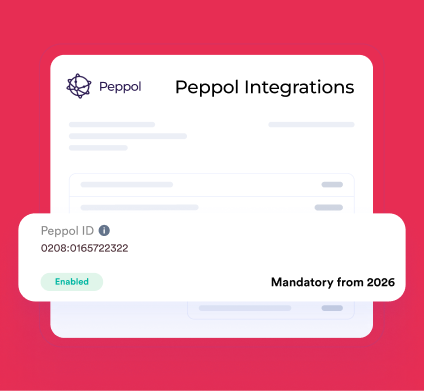






Are you ready to digitize your invoicing process and do you want to understand how Peppol works? No worries. Below you will find a clear and complete explanation in plain language so you fully understand this standard for digital invoicing. From 2026 onwards, sending invoices via Peppol will be mandatory. You can already prepare for this digital transition by switching to Dexxter, which allows you to send Peppol invoices and keep track of your accounting starting today.
1. PEPPOL (Pan European Public Procurement Online)
PEPPOL is an advanced digital network that allows you to exchange invoices easily and securely with companies and public authorities across Europe. You can see it as an efficient digital highway for your invoices.
Benefits for your business:
- Future-proof. From 2026 onwards, Peppol will be mandatory, so you stay ahead of legislation.
- Faster payments. Invoices are processed immediately, which significantly shortens processing times.
- Lower administrative workload. Automation reduces manual work and paper usage.
- Higher accuracy. Digital processing reduces the risk of errors.
2. Access Point
Your Access Point acts as your secure gateway to the Peppol network. It ensures that invoices are sent and received safely.
What this means for you:
- Seamless integration. The Access Point works in the background so you can focus on your core activities.
- Automatic processing. Your accounting software usually handles this for you.
- Secure communication. The Access Point ensures a secure connection to the Peppol network.
3. E-invoice
An e-invoice is more than a digital document. It follows a structured format that can be processed directly by accounting software.
Benefits of e-invoicing:
- Higher efficiency. Automatic processing saves time and reduces errors.
- Faster payments. Immediate processing often results in quicker payments.
- Cost savings. Less manual work leads to lower processing costs.
Pro tip: We offer a convenient tool that allows you to create a sample Peppol invoice in XML yourself. This helps you understand what an e-invoice actually looks like.
4. Digital invoice
What it is:
A digital invoice is created, sent, received and processed electronically. This can range from a simple PDF file to a structured data file such as a Peppol e-invoice.
Why it matters:
- Speed. Digital invoices are sent and received faster than paper invoices.
- Cost savings. You save on paper, printing and postage costs.
- Eco-friendliness. Less paper consumption reduces environmental impact.
- Improved storage. Digital invoices are easier to archive and retrieve.
How it differs from a Peppol e-invoice:
A digital invoice is a broad concept that includes all electronic invoice formats.
Peppol e-invoices are a specific type of digital invoice that meets strict structured data standards.
5. E-invoicing
What it is:
E-invoicing is the process of creating, sending and receiving invoices in a structured electronic format that allows direct processing in financial systems. It is the abbreviation of electronic invoicing.
Why it matters:
- Automation. Enables fully automated invoice processing.
- Error reduction. Eliminates manual data entry.
- Efficiency. Speeds up the entire invoice-to-payment process.
- Cost savings. Reduces processing costs and improves cash flow.
Key characteristics of e-invoicing:
- Use of standardized formats such as those used within Peppol.
- Direct integration with accounting and ERP systems.
- Real-time tracking of invoice status.
- Compliance with legal requirements for electronic invoicing.
Relation to Peppol:
Peppol is a specific network and set of standards for e-invoicing.
E-invoicing is the general concept; Peppol is one way to implement it.
6. Mercurius
What it is:
Mercurius is the Belgian platform for e-invoicing to government institutions. It is based on Peppol standards and is part of the wider European e-invoicing network.
Why it matters:
- Mandatory usage. Invoicing the Belgian government requires Mercurius.
- Efficiency. It streamlines invoicing between businesses and government bodies.
- Faster payments. Processing and payment often happen more quickly.
- Standardization. It promotes standardized e-invoicing in Belgium.
How Mercurius works:
- You create an e-invoice in your own system or via a service provider.
- The invoice is sent through the Peppol network to Mercurius.
- Mercurius delivers the invoice to the correct government entity.
- The government processes the invoice in its own system.
Relation to Peppol:
- Mercurius uses Peppol standards and infrastructure.
- If you already use Peppol, you usually do not need extra adjustments to invoice via Mercurius.
- Mercurius is a good example of how national platforms align with European standards.
7. Digital mailbox
What it is:
Your digital address within the Peppol network. Comparable to an email address, but specifically for receiving e-invoices and other business documents.
Why it matters:
- Ensures invoices always reach the correct destination.
- Makes your business discoverable to other Peppol participants.
- Centralizes all incoming invoices in one place.
8. Peppol Directory
What it is:
An online directory of all companies and organizations connected to the Peppol network. You can compare it to a phone book for e-invoicing.
Why it matters:
- Discoverability. You can easily check which partners already use Peppol.
- Network expansion. Helps you find new customers or suppliers using Peppol.
- Reliability. Allows you to verify Peppol details of your business partners.
How to use the Peppol Directory:
- Visit the Peppol Directory website.
- Search by company name, Peppol ID or other identifiers.
- Check whether a company can receive Peppol invoices.
- Keep your own company details up to date so others can find you.
9. Peppol-ready
This term indicates that a software system or business is ready to work with Peppol. All necessary technical preparations have been completed.
Why it matters:
- Certainty. You know the software is compatible with Peppol.
- Future-proof. You are prepared for increasing adoption of e-invoicing.
- Efficiency. You can start using Peppol immediately.
What to look for in Peppol-ready software:
- Ability to create and send Peppol invoices.
- Ability to receive and process Peppol invoices.
- Integration with the Peppol Directory.
- Support for multiple Peppol document types.
10. Connector
A connector is a software module that links your existing systems to the Peppol network.
Why a connector is valuable for your business:
- Ease of use. You continue working in your familiar Dexxter environment.
- Seamless integration. No need to replace your accounting system.
- Cost-efficiency. You benefit from Peppol without major software investments.
11. Peppol Authority
Each participating country or region has its own Peppol Authority. In Belgium, the national Peppol Authority is the Federal Public Service Policy and Support (BOSA).
12. API (Application Programming Interface)
An API allows different software systems to communicate with each other. Within Peppol, an API enables software like Dexxter to connect to the Peppol network.
13. Certification
Certification within Peppol shows that a company or software provider meets specific quality and security requirements. The goal is to make Dexxter Peppol certified as well.
14. UBL (Universal Business Language)
UBL is the standard format used for Peppol e-invoices. It acts as a universal language that ensures invoices are readable regardless of the software used by the recipient.
What UBL means for your business:
- Future-proof. The standard evolves with market needs.
- Universal compatibility. Your invoices are readable by all Peppol participants.
- Simplified international trade. Cross-border invoicing becomes easier.
15. Service provider
A service provider is your partner within the Peppol network. This party helps you connect to Peppol and handles all technical aspects.
How a service provider supports your business:
- Technical implementation. They manage the connection to the Peppol network.
- Compliance. They ensure you comply with all Peppol standards and rules.
- Support. They provide technical assistance and keep you informed of updates.
By working with a reliable service provider, you can focus on your core activities while they ensure a smooth Peppol integration.
16. SMP (Service Metadata Publisher)
The SMP functions as the digital address book of Peppol. It contains registration details of all participating companies and public institutions.
What the SMP means for your daily operations:
- Time savings. No more manual searching or verifying invoice details.
- Automatic addressing. No need to manually check or update addresses.
- Reliable delivery. You can be confident invoices reach the correct recipient.
17. Participant ID
Your participant ID is your unique identification number within the Peppol network. It makes your business recognizable and discoverable for other participants.
Why your participant ID matters:
- Enhanced security. Only you can send invoices using your ID.
- Unique identification. Prevents confusion with other companies.
- Efficient communication. Other businesses can easily find and contact you.
18. Interoperability
Interoperability ensures that all systems within Peppol can communicate seamlessly, regardless of the software being used.
How your business benefits:
- Simplified processes. Systems work smoothly together.
- Flexibility. You can work with any Peppol participant.
- Future-proof. No need to change systems for new partnerships.
19. AS4
AS4 is the secure messaging protocol used by Peppol to ensure safe data exchange.
What AS4 means for invoice security:
- Integrity. Ensures invoices arrive unchanged.
- Encryption. Data is encrypted so only the intended recipient can read it.
- Authentication. Confirms the identity of the receiving party.
20. Validation
Validation is the process in which the system checks whether your e-invoice meets all technical and legal requirements before it is sent.
How validation improves your invoicing process:
- Error reduction. Issues are detected before sending.
- Faster processing. Correct invoices are processed more quickly.
- Professional image. You always send compliant, error-free invoices.
21. Peppol ID
Your Peppol ID is identical to your participant ID. It is your unique identifier within the Peppol network.
Why your Peppol ID is important:
- Professional image. Shows your business is ready for digital invoicing.
- Unique recognition. Ensures invoices always reach the correct recipient.
- Easy discoverability. Other companies can easily find you.
22. eDelivery
eDelivery is the transport mechanism used by Peppol to send electronic documents safely and efficiently.
How your business benefits from eDelivery:
- Improved efficiency. Faster document exchange streamlines processes.
- Fast delivery. Documents reach their destination quickly.
- High reliability. You can trust that invoices are delivered.
23. CEN/TC 434
CEN/TC 434 is the European committee that defines standards for e-invoicing. It ensures e-invoicing works consistently across Europe.
What this means for your daily operations:
- Future-proof. Always aligned with European regulations.
- Uniformity. Invoices automatically comply with EU standards.
- Ease of international trade. Seamless invoicing across EU borders.
24. GLN (Global Location Number)
A GLN is a unique identification number used worldwide to identify physical locations, companies or departments. Within the Peppol network, a GLN can function as an address for sending and receiving electronic documents such as e-invoices.
GLNs are part of the GS1 standard and are commonly used in retail, healthcare and logistics. By using a GLN within Peppol, invoices are delivered directly to the correct department or location within larger organizations. This reduces miscommunication and speeds up invoice processing.
Within Peppol, the GLN helps identify the correct recipient, which is especially useful for companies with multiple locations or departments.
25. Peppol protocol
The Peppol protocol is the set of rules and standards that define how data is exchanged within the Peppol network. It includes all technical specifications and procedures required for secure and efficient communication.
Why the Peppol protocol matters for your business:
- Uniformity. All participants communicate in the same way regardless of location or software.
- Reliability. Fixed procedures reduce the risk of errors or miscommunication.
- Security. Built-in safeguards protect your data during transfer.
- Future-proof. The protocol is regularly updated to meet new technological and legal requirements.
Understanding and applying these concepts allows you to fully benefit from Peppol. It helps you work more efficiently, minimize errors and prepare your business for the future of digital invoicing.