










As a self-employed professional, you naturally want to deduct as many business expenses as possible. That makes perfect sense, because the more expenses you can deduct, the lower your taxable profit, and thus your taxes.
Unfortunately, the tax authorities don’t always see it that way. Some expenses are partially restricted, these are called disallowed expenses. In this article, we focus specifically on restaurant costs, reception costs, and business gifts.
What exactly are disallowed expenses?
Disallowed expenses are costs you’re allowed to record as business expenses, meaning they can be 100% professional. However, they are not fully tax-deductible. A portion has to be added back into your taxable income. In other words, that part is disallowed.
That may sound odd, but the logic is simple: the government wants to discourage certain types of spending.
Three common disallowed expenses
This article zooms in on three categories that frequently appear in the books of small business owners:
- Restaurant costs
- Reception costs
- Business gifts
In all three cases, part of the cost is not tax-deductible, even when it’s clearly a business-related expense.
Another cost category where disallowed expenses apply is car-related costs. Want to know more? Be sure to check out our article on that topic!
1. Restaurant costs: 31% disallowed
Lunch with a client or grabbing a sandwich with a supplier? These can be fully justifiable, 100% professional expenses. Still, the tax authorities say: only 69% is tax-deductible, the remaining 31% is automatically disallowed.
Why 31%?
The government assumes there is always a personal element involved with restaurant costs. After all, we all eat and drink, whether it’s business-related or not. That’s why there’s a standard 31% deduction limit.
Concrete example:
You pay €100 for a business lunch.
→ You can log the full €100 as a cost in Dexxter.
→ But for your taxes, €31 is marked as a disallowed expense.
→ Only €69 is counted as a deductible cost.
2. Reception costs: 50% disallowed
Reception costs are expenses made to receive clients, suppliers, or other business contacts in style. Think of hosting a reception, organizing an open house, or decorating your welcome area.
Why 50%?
According to the tax authorities, these costs are more about image and relationship management than the core activity of your business. As a result, 50% is disallowed, even if the expense is clearly business-related.
3. Business gifts: 50% disallowed
A bottle of wine for a loyal client? A holiday gift for your suppliers? These are typical examples of business gifts you might want to offer as an entrepreneur. Even when the gift is clearly business-related, 50% is automatically disallowed.
Why 50%?
Even if business gifts are entirely professional, the tax authorities see them as partially personal or not directly tied to your business operations. The logic is that such expenses contribute less directly to your business, so only half is deductible.
How is this handled in Dexxter?
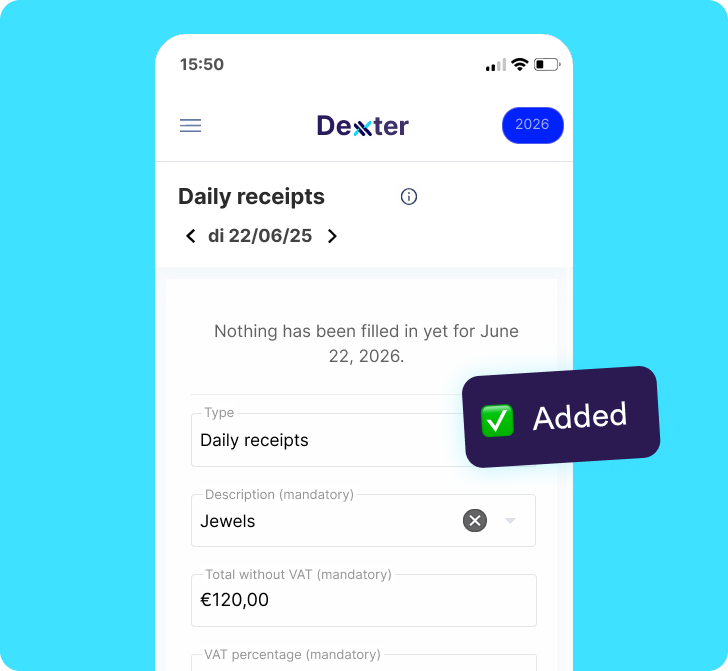
Good news: when you log one of these costs in Dexxter, you don’t have to worry about the percentages. Dexxter automatically calculates the disallowed expenses based on the cost category you select.
Examples:
→ Logging a restaurant cost? Dexxter automatically disallows 31%.
→ Logging a business gift or reception cost? Dexxter applies the 50% rule.
Everything is correctly processed in your tax return. Clear and simple.
In conclusion
Disallowed expenses are not a punishment, but a fiscal correction. Understanding how they work helps you avoid surprises when calculating your taxes.
Note: they do not affect your VAT return, but they do impact your social contributions and personal income tax.
And thanks to Dexxter, you don’t need to worry about handling them, we do it for you.