












When you decide to discontinue your sole proprietorship, there is more to it than just paperwork. You are not only stopping invoicing, but also ending a period full of plans, stress, and pride. Of course, you still have to report your closure to the Crossroads Bank for Enterprises (CBE) and the VAT administration. You can do this through your social secretariat.
Then there is that one question that every self-employed person asks themselves sooner or later: “What do I do with all my business assets?”
Your laptop, your office chair, maybe even your van: they don’t just vanish into thin air.
In this article, we take you step by step through the settlement process to see what happens to your investments, depreciations and VAT when you decide to quit.
What do we mean by “business assets”? 📒
Everything you have ever purchased for your business and use professionally belongs (for a certain percentage) to your company. Examples include:
- Laptop, smartphone or printer
- Tools or machines
- Office furniture
- Company car
These purchases are recorded in your accounts and are depreciated. This means that you have spread their cost over several years as a professional expense.
What happens to those assets when you stop? 🚧
When you close your sole proprietorship, the tax authorities consider it as if you are selling all your business assets to yourself. That may sound a bit strange, but that way everything is processed correctly in your accounting.
You determine the market value for each item, which is the price you would get for it today.

Tip:
Check second-hand websites or ask a dealer for an estimate to determine a realistic value.
Do you need to issue an invoice to yourself? 🧾
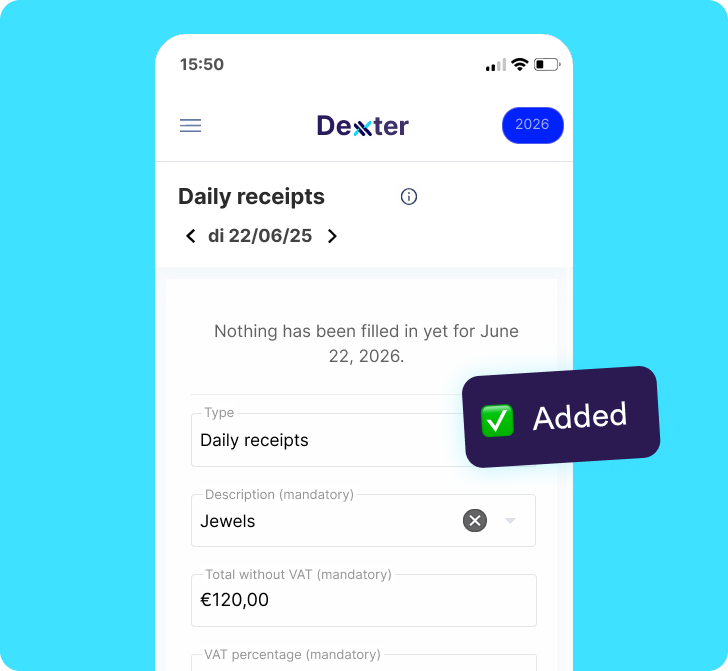
Yes. You issue a sales invoice to yourself for the value of each item. You don’t need to transfer any money, but the invoice ensures that everything is properly recorded. With Dexxter, you can do this in just a few clicks.
Example:
You have an office chair with a residual value of €100.
The market value is €80.
You issue an invoice to yourself for €80 (excluding VAT).
This ensures that your accounting remains correct until the last day.
Important!
If you are subject to VAT, you must also charge VAT on these sales to yourself. That way, your final VAT return will be correct.

What if something is no longer worth anything? 💸
Certain items have had their day. Do you still have an old printer, a worn-out toolbox, or a cell phone that no longer works? Then you can set the market value to zero.
Example
Your old printer is broken and no one would pay anything for it.
The market value = €0.
You no longer need to process an invoice or VAT.
What if the market value differs from the accounting value? 📊
That difference is important. There are three possible situations:
| Situation | Meaning | Consequence |
| Market value = residual value | Everything is correct | No correction needed |
| Market value > residual value | You have made a profit | Capital gains are taxed! |
| Market value < residual value | You have a loss | Lower value is accepted |
Example of capital gains
You bought an office space for €100,000 and depreciate it over 20 years (€500 per year).
After those 20 years (your office space is now fully depreciated), you decide to stop and sell the office.
Due to rising real estate prices, the office space is now worth €120,000.
You are taxed on the capital gain of €20,000.
➡️ This is also the reason why we do not recommend including real estate in your accounting.
But capital gains are also applicable in this more common situation:
You purchased a machine for €3,000 and depreciate it over five years (€600 per year).
After three years, you decide to stop. The residual value is then €1,200.
The market value is €1,500.
You will be taxed on the capital gain of €300.
What about VAT when you close your sole proprietorship? 🪙
If you ever claimed VAT back on the purchase of an investment, you will need to check whether a VAT adjustment is required when you close your business.
This depends on the adjustment period:
- 5 years for movable property (such as computers or machines)
- 15 years for immovable property (such as buildings)
- During an audit, the tax authorities will check whether you have applied this adjustment correctly.
Example
Three years ago, you purchased a machine with €1,000 VAT and deducted the VAT in full.
You are now closing your business, so there are two adjustment years remaining.
You must pay back 2/5 of that VAT: €400.
In a nutshell 🌰
When you shut down your sole proprietorship:
- Make an inventory of your assets.
Think of all your professional goods: laptop, car, machines, etc. - Determine their market value.
What are they worth today? - Sell them to yourself.
Draw up an invoice, even if you are not actually paying yourself. - Check the VAT.
Verify whether you need to adjust or pay back anything. - Be alert for capital gains!
Especially with real estate or goods that retain their value. - Keep all supporting documents.
The tax authorities may carry out a closure audit.
Conclusion
Closing a business is a delicate matter. You are not only closing a chapter, but also your accounts. By correctly valuing your assets, adjusting VAT and settling your depreciations properly, you can avoid problems later on.
A good accountant will help you navigate the rules. And with an online tool such as Dexxter, you can easily keep track of everything.
Useful information If you are discontinuing your sole proprietorship
Stopping your sole proprietorship: what about depreciations?
Depreciations in a sole proprietorship: everything you need to know
Discontinuing your sole proprietorship?
Three reasons why you are better off not putting your house or home office in as a cost