







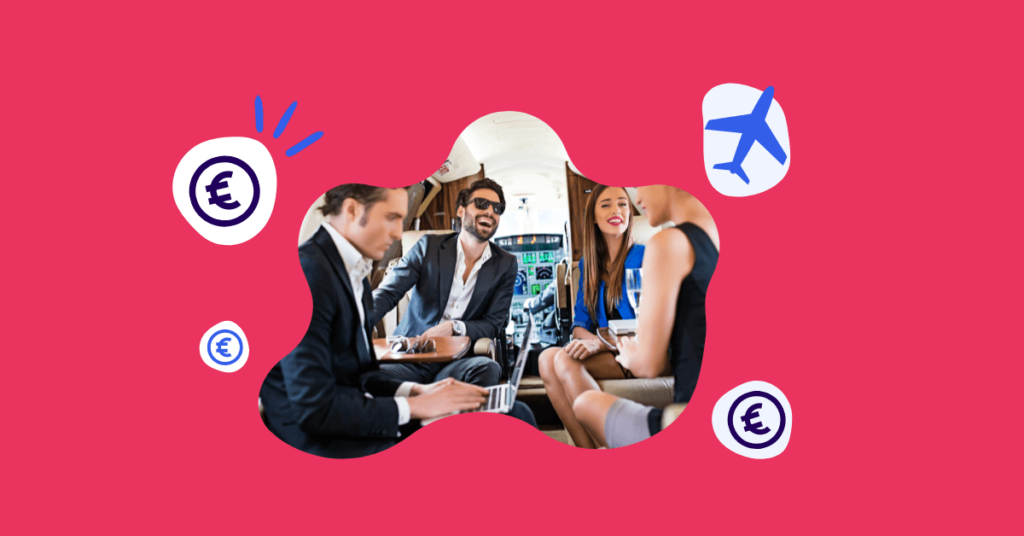
Going on a business trip for your sole proprietors? Top! 👏 But did you know that you can enter some of those costs in your accounts? In this article, we explain to you step by step exactly which travel expenses are deductible and how to go about it for your accounting.
What are business travel expenses? 🔎
Before we dive into the details, it’s good to have a clear understanding of what exactly constitutes business travel expenses. It refers to any expenses you incur while travelling on business for your company:
- Transport costs such as air tickets, train tickets, rental cars and refuelling
- Hotel costs for your overnight stays
- Meals and catering
- Local transport such as taxis, public transport or Uber
- Entrance tickets to events, fairs or training courses
If you incur these costs as a function of your self-employed activities, they are (partly) deductible as professional expenses. Yes! 🥳
When are travel expenses business expenses? ✈️
OK, but what exactly makes a trip ‘business’? That is sometimes a grey area. In general, if the trip has a clear professional purpose, then it is a business trip. Think of:
- Visiting a (potential) customer or supplier
- Having dinner with a business relation
- Attending a trade fair, conference or training course
- Visiting a branch or office of your company
- Negotiations or meetings with business partners

Attention! 🏝️
Just going on a city trip or holiday? Then unfortunately the expenses are not deductible as there is no professional purpose.
Supporting documents are crucial 📃
If you are a sole proprietor, you are required to prove the actual expenses with receipts or invoices. Do you want to be able to actually claim those travel expenses as expenses? Then it is also important that you keep supporting documents proving the business purpose! This is because the tax authorities may question you to substantiate the business nature of your travel.
Some examples of evidence:
- Emails or diaries with appointments
- Business cards from new business contacts
- Photos from the locations or event
- Leaflets, programmes or course materials
- Flight tickets and hotel invoices
The more evidence you can present, the better you can prove the business case for your trip. So keep everything carefully!
Mixed trips: private and business ⚖️
Many entrepreneurs like to combine the useful with the pleasant. Your business trip in New York, for example, coupled with a few days’ city trip. Or having your partner travel with you for some quality time. It can be done, but then the private costs should be strictly separated from the business costs.
Say you booked a flight from €500 and a hotel for €1000. You stayed there for 5 nights, of which 3 were business and 2 private. Then you could book €300 (3/5 from €500) and €600 (3/5 from €1000) respectively. The other €700 are private expenses.
Note that if the partner goes along and there are joint expenses (think of a hotel room). Then 50% private use must also be applied to these joint expenses.

Attention!
The tax authorities look at this strictly! So make sure you can demonstrate a clear allocation key.
Reclaim deductible vAT 💶
During your foreign business trip, you often pay vAT on expenses such as fuel, tolls or hotel costs. You cannot simply recover this foreign VAT via your Belgian vAT declaration.
Fortunately, there is a solution: the so-called ‘VAT-refund system’. This allows you to simply reclaim the foreign vAT in the country where you paid it! The condition is that you keep the original invoices and proofs good. Click here for more info.

Tip!
Curious about the latest accounting tips & tricks? Then be sure to follow a free webinar and/or course!